I'm a bilingual yoga teacher who helps people who sit a lot gain mobility, move without pain and reduce their stress.
What a VR game teaches us about pain
|
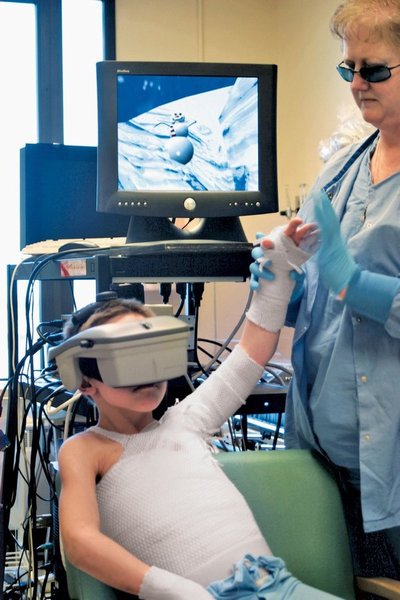
A few weeks ago, I talked about persistent pain that doesn't seem to have a clear explanation. The tests that show nothing, the doctors who sound increasingly skeptical... and us, wondering if we are not getting mad? There's something else I'd like you to know about that. We now know that pain isn't a direct readout of damage in our body, but a decision our brain makes. Your brain is constantly gathering information. The state of your tissues, yes, but also your emotional state, your sense of safety, your past experiences, your expectations, the context you're in. It weighs all of it, estimates the level of threat, and produces pain accordingly. (This is called the biopsychosocial model of pain.) This is why there's no reliable correlation between physical damage and pain intensity. Some people have significant disc herniations and feel nothing. And unfortunately, others are in severe pain with nothing visible on their scans. This is also why there are soldiers who don't feel their injuries while they're on the battlefield... and then feel everything once they're safe. An incredible illustration of this process was shown in an experiment called "Snow World". A scientist called Hoffman hooked severe burn patients to an immersive virtual reality game during their wound dressing. Before that, some patients actually refused treatment because of the immense pain it caused. But once they were immersed in "Snow World", their pain levels dropped significantly. From 10/10 to a 4/10 in some cases, without any change in their physical condition. What changed was the brain's attention, and its perceived level of threat.
Obviously, none of this means the pain is imaginary. What it means is that the pain is real, and it is also influenced by far more than just the tissue. Take from this: calming the nervous system is a legitimate way of reducing the brain's threat response. Slow movement, gentle breathwork, feeling safe in your body again... they are not just nice to have (even though they do feel good!), they are part of how persistent pain actually resolves. Something to try this week: next time you feel pain or tension somewhere, instead of bracing against it, try breathing into it slowly for 30 seconds. And notice whether the sensation shifts at all. Om, peace 🧡 Clem |
Clémence Dieryck
I'm a bilingual yoga teacher who helps people who sit a lot gain mobility, move without pain and reduce their stress.

Yoga with Clem turns 10 this year 🥳 And I've turned 40. That felt like a good moment to look back with something more honest than a highlight reel. So I recorded an episode sharing the 10 mini habits that have genuinely made a difference over the past decade. True to my philosophy, I'm not sharing big impressive habits, but the ones that actually stuck. Some came from yoga. Some from running a business on my own for ten years. A couple from realising, slowly, that willpower is a terrible...
I talk about the pelvic floor a lot with my pregnant clients. They quickly understand how important this kind of work is to keep them comfortable during pregnancy and for their postpartum recovery. But the pelvic floor isn't just a women's health topic. You might be surprised to learn that... men have one too! It's just as worth looking after, but nobody talks about it. sorry about the unsollicited d*ck pic The pelvic floor is a group of muscles, kinda like a hammock at the base of the...
If you've ever been mid-yoga session and heard a loud crack from your knee, a pop in your shoulder, or an unexpected sound from somewhere lower 🫢 you're in good company. Body noises during practice are incredibly common, and they're one of those things people quietly wonder about but rarely ask. So let's talk about it! The three types of sounds that can come from your joints (and when to worry) The first is cavitation: the same mechanism behind knuckle cracking (btw, it used to be so common...